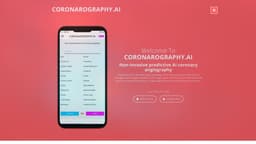
Coronarography.AI
AI-based Coronarography accurately predicts coronary artery pathology using non-invasive ECG images.
Introduction
Coronarography.AI is a non-invasive predictive AI coronary angiography application that utilizes artificial intelligence technologies to determine the pathology of the coronary arteries. By uploading an ECG image and selecting risk factors, the AI can predict the presence of myocardial ischemia, a cardiac pathology based on the main arteries of the heart.
What stands out?
1. Non-invasive predictive AI coronary angiography 2. Early detection of acute conditions related to coronary artery occlusion, subocclusion, and stenosis 3. Immediate results with high accuracy 4. Support for risk factor selection 5. Upload of ECG images in JPEG or PNG format 6. Dynamic visualization of results 7. Predictive analysis for changes in risk factors and health conditions 8. Developed by cardiologist Timur Pulatovich Abdualimov
Frequently Asked Questions
What is Coronarography.AI?
How to use Coronarography.AI?
More Information
Coronarography.AI Support Email & Customer service contact & Refund contact etc.
Here is the Coronarography.AI support email for customer service: [email protected] . More Contact, visit the contact us page(https://coronarography.ai/#mu-contact)
Reviews & Feedback
Share your experience with the community
0.0
Based on 0 reviews
User Comments (0)
Sort Criteria
Order
No reviews yet. Be the first to share your thoughts!
Statistics
Monthly visits
NaN
Saved by users
0
Rating
0.0/ 5.0
Added on
—

Use Cases
- 1. Assessing the presence of myocardial ischemia 2. Identifying coronary artery pathology 3. Monitoring the likelihood of revascularization 4. Screening for coronary heart disease 5. Tracking changes in pathology based on risk factors and ECG images 6. Early identification of acute coronary conditions 7. Facilitating timely specialist consultations
How to Use
To use Coronarography.AI, simply upload an ECG image in JPEG or PNG format and select relevant risk factors. The AI system, trained with deep neural networks, will analyze the image and provide immediate results indicating the presence or absence of coronary artery pathology and the likelihood of revascularization. The user can dynamically track the results and explore different scenarios such as changes in risk factors or the development of specific health conditions.