
Landing.ai
Landing AI offers LandingLens, a cloud-based computer vision platform for creating custom projects easily.
Introduction
Landing AI is a computer vision platform and AI software company that offers a cloud-based computer vision software platform called LandingLens. It allows users to create custom computer vision projects in minutes via natural prompting interactions, making it fast, easy, and intuitive to build computer vision systems.
What stands out?
Visual Prompting: Fast and easy way to have vision-based interactions by prompting the system
Data-Centric AI: Ensures models work even with small datasets by ensuring data quality
Flexible Deployment: Cloud and edge device deployment options to integrate into existing environments
Unlimited Scalability: Allows scaling projects from a single production line to worldwide operations
Frequently Asked Questions
What is Landing.ai?
How to use Landing.ai?
What is Landing AI?
How does LandingLens work?
What are the core features of LandingLens?
What industries can benefit from LandingLens?
More Information
Landing.ai Support Email & Customer service contact & Refund contact etc.
Here is the Landing.ai support email for customer service: [email protected] . More Contact, visit the contact us page(https://landing.ai/contact-sales/)
Landing.ai Company
Landing.ai Company address: 195 Page Mill Rd, Palo Alto, CA. 94306.. More about Landing.ai, Please visit the about us page(https://landing.ai/about-us/).
Landing.ai Login
Landing.ai Login Link: https://app.landing.ai/login/
Landing.ai Sign up
Landing.ai Sign up Link: https://app.landing.ai/signup/
Landing.ai Pricing
Landing.ai Pricing Link: https://landing.ai/pricing/
Landing.ai Facebook
Landing.ai Youtube
Landing.ai Tiktok
Landing.ai Tiktok Link: https://www.tiktok.com/@landing.ai
Landing.ai Linkedin
Landing.ai Linkedin Link: https://www.linkedin.com/company/landing-ai/
Landing.ai Twitter
Landing.ai Twitter Link: https://twitter.com/landingAI
Landing.ai Instagram
Landing.ai Instagram Link: https://www.instagram.com/landingai/
Landing.ai Github
Landing.ai Github Link: https://github.com/landing-ai/
Reviews & Feedback
Share your experience with the community
0.0
Based on 0 reviews
User Comments (0)
Sort Criteria
Order
No reviews yet. Be the first to share your thoughts!
Statistics
Monthly visits
NaN
Saved by users
0
Rating
0.0/ 5.0
Added on
—
Similar Tools
Pixelcut
Easily create stunning product photos and ads with our free online design tool. Remove backgrounds and erase objects effortlessly.
Wondershare
Discover innovative tools for enhancing creativity, productivity, and efficiency with our app. Unleash your potential today!
TurboScribe
Unlimited AI transcription with 99.8% accuracy in 98+ languages.
Intercom
Get quicker solutions with Automation and human assistance. Enhance support efficiency for faster issue resolutions.
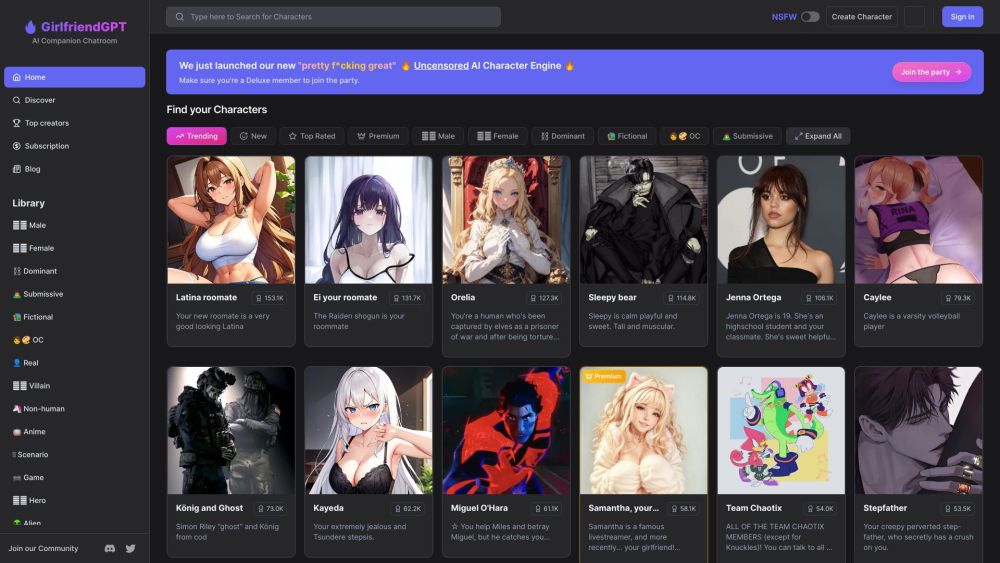
GirlfriendGPT - The AI Companion Chatroom
An uncensored AI companion chatroom for SFW and NSFW conversations.
Use Cases
- Automotive: Quality inspection, defect detection, and autonomous driving
- Electronics: Quality control, PCB inspection, and component recognition
- Food & Beverage: Quality assurance, contamination detection, and package inspection
- Medical Devices: Defect identification, product verification, and quality control
- Life Sciences: Cell identification, drug discovery, and research analysis
- Agriculture: Crop monitoring, disease detection, and yield optimization
- Manufacturing: Production line monitoring, defect detection, and process optimization
- Infrastructure: Facility management, safety monitoring, and object recognition
- Pharma: Drug packaging verification, counterfeit detection, and quality control
- EV Manufacturing: Battery inspection, component recognition, and production optimization
How to Use
To use LandingLens, users can upload images by dragging and dropping them directly into the platform or capturing live images from their webcam. They can label objects in the images using the LandingLens labeling tool, which helps create high-quality training data for maximum accuracy. After labeling, users can train their model and evaluate its performance. Once the model is accurate enough, it can be deployed to the cloud or edge devices with just a few mouse clicks. Users can monitor the model's performance and update it as needed.